
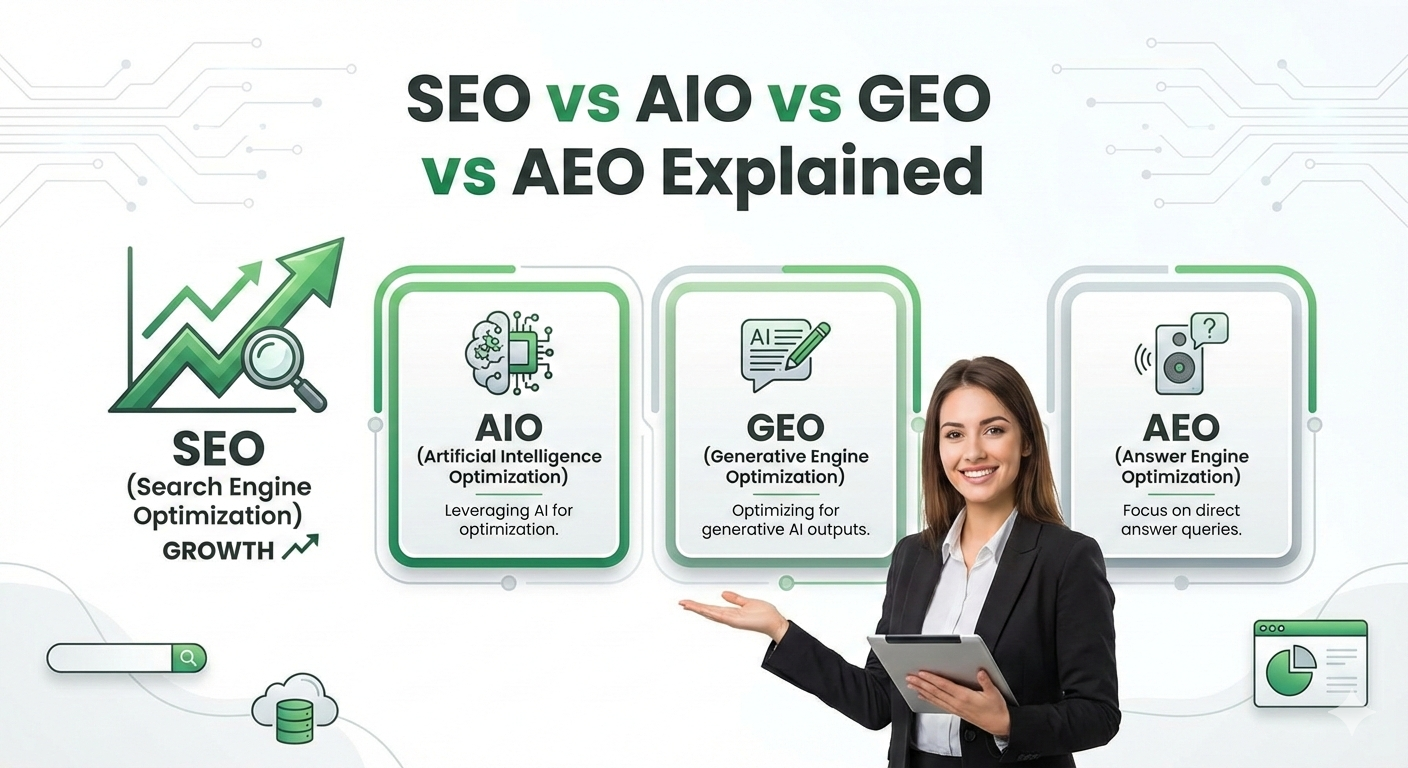
Search optimization is no longer just about ranking blue links on Google. In 2026, visibility across AI-powered search engines has become equally—if not more—important than traditional rankings.
This guide breaks down the real differences between SEO, AIO, GEO, and AEO, how each works in modern search ecosystems, and how businesses should adapt their content strategy for AI-first search engines like Google AI Overviews, Gemini, Bing AI, ChatGPT, and Perplexity.
We’ll cover:
- What each optimization model actually means
- Where traditional SEO still dominates
- How Generative Engine Optimization (GEO) and Answer Engine Optimization (AEO) change content discovery
- Why Artificial Intelligence Optimization (AIO) is the umbrella strategy for the future
Why Search Optimization Is Changing Faster Than Ever?

Search engines are undergoing the biggest transformation since Google introduced PageRank. The shift from keyword-based rankings to AI-driven understanding and answer generation has redefined how content is discovered, evaluated, and surfaced.
Evolution from Traditional Search Engines to AI-First Search
Traditional search engines focused on matching keywords to indexed pages. Today, AI-first search engines use semantic search, entity-based understanding, and natural language processing (NLP) to interpret intent rather than exact phrases.
Instead of asking “Which page should rank #1?”, modern systems ask:
“Which source best answers this question in context?”
This shift is driven by Generative AI and Large Language Models (LLMs) that synthesize information across multiple sources.
Rise of Zero-Click Search Results
With the growth of:
- Google AI Overviews
- Featured snippets
- People Also Ask
- Voice assistants
users increasingly get answers without clicking any website. These zero-click search results reward content that is:
- Direct
- Structured
- Entity-rich
- Answer-focused
This is where AEO and GEO outperform traditional SEO alone.
Shift from Rankings → Visibility → Citations
In AI-driven search, success is no longer measured only by rankings.
The new hierarchy looks like this:
- Rankings (SEO)
- Visibility in answers (AEO)
- Citations and mentions in AI summaries (GEO)
Content that is not cited or summarized by AI models becomes invisible—even if it technically ranks.
Role of Generative AI & Large Language Models (LLMs)
LLMs like those powering Google Gemini, ChatGPT, Bing AI, and Perplexity:
- Understand entities, not just keywords
- Generate answers using knowledge synthesis
- Favor authoritative, context-rich sources
- Evaluate trust signals, topical authority, and semantic relevance
This fundamental change is why SEO alone is no longer sufficient in 2026.
SEO vs AIO vs GEO vs AEO — Quick Comparison Table (Bookmark This)
Below is a high-level comparison to help you instantly understand how each optimization model differs and where it fits in a modern strategy.
| Factor | SEO | AEO | GEO | AIO |
|---|---|---|---|---|
| Primary Focus | Rankings in SERPs | Direct answers | AI-generated summaries | Holistic AI optimization |
| Main Goal | Organic traffic | Zero-click visibility | AI citations & mentions | Search ecosystem dominance |
| Content Format | Long-form pages | FAQs, concise answers | Entity-rich, authoritative content | Multi-format, AI-aligned |
| Key Platforms | Google Search | Google PAA, voice assistants | Google AI Overviews, Gemini, Perplexity | All AI-powered search engines |
| Primary KPIs | Rankings, clicks | Snippet ownership | Citations, mentions | Visibility + authority |
| Best Use Cases | Blogs, websites | How-to & Q&A content | Thought leadership, research | Brands & agencies |
Why This Comparison Matters
Most marketers ask:
“Which is better: SEO, AEO, GEO, or AIO?”
The real answer is:
- SEO builds the foundation
- AEO captures answers
- GEO earns AI trust and citations
- AIO connects everything into a future-proof system
This is not a replacement model—it’s an evolution of search optimization strategies.
GEO vs SEO in 2026
Generative Engine Optimization (GEO) prioritizes context-rich answers for AI summaries over traditional crawlability. For local businesses, traditional SEO builds foundational local pack rankings, while GEO enhances AI recommendations via authoritative sources—combine for 10-20% visibility gains.
AEO and Synergies
Answer Engine Optimization (AEO) targets conversational queries with how-to schema and direct responses, complementing SEO’s detailed content. Integrate with GEO for multi-platform success: SEO indexes, AEO extracts, GEO synthesizes.
Implementation Roadmap
- Audit content for E-E-A-T and semantic entities using tools like Semrush.
- Optimize with NLP-friendly structures: short paragraphs, quotable stats, entity links.
- Track via AI citation tools for Share of Model improvements over 3-6 months.
Prioritize SEO foundation, layer AEO/GEO for AI era dominance—ideal for Delhi-based marketers targeting voice assistants.
SEO vs AEO: Key Differences You Must Understand
The difference between SEO and AEO lies primarily in content format and performance measurement. SEO traditionally favors comprehensive, long-form content designed to rank for broader keyword themes. AEO prioritizes concise, structured answers that can be surfaced immediately.
From a results perspective, SEO aims to drive organic traffic through clicks, while AEO focuses on zero-click visibility. In many cases, AEO sacrifices traffic volume in exchange for authority, brand recognition, and repeated exposure within answer engines. Understanding this distinction is critical when evaluating SEO vs AEO vs GEO strategies for modern search.
AEO Tactics That Actually Work
Effective AEO relies heavily on structured data and schema markup. FAQ schema and How-to schema help search engines clearly identify questions and answers within your content. This structured approach improves eligibility for featured snippets and People Also Ask placements.
Conversational queries are another core component of AEO.
Content should reflect how users naturally speak and ask questions rather than how they type keywords. Structured data reinforces this by giving answer engines machine-readable context, increasing the likelihood that content is selected for AI-generated answers.
What Is GEO? (Generative Engine Optimization)
Generative Engine Optimization, or GEO, focuses on optimizing content so it can be cited, summarized, or referenced by generative AI systems. Unlike SEO and AEO, GEO does not prioritize rankings or snippets. Its primary goal is visibility within AI-generated summaries produced by systems such as Google AI Overviews, Gemini, Perplexity, and Bing AI.
AI summaries are generated through knowledge synthesis, where large language models evaluate multiple sources, extract entities, and generate context-rich answers. GEO ensures that content is written in a way that these systems can trust, understand, and reference.
Topical authority plays a central role in GEO. Content must demonstrate depth, consistency, and expertise across an entire subject area. Citation-worthy content is factual, well-structured, and aligned with authoritative sources. Entity trust signals, including clear definitions, expert tone, and semantic consistency, help generative engines determine which sources are reliable.
Compared to traditional SEO, GEO shifts the focus from keyword rankings to AI trust and summarization potential. This distinction is why GEO vs SEO comparisons are increasingly important in the AI-first search era.
How GEO Works in AI Search (Google SGE, Gemini, Perplexity)
In AI search environments, GEO works by aligning content with how large language models process information. These systems rely on entity recognition, contextual relevance, and source credibility to synthesize answers. Rather than ranking a single page, AI models generate responses that combine insights from multiple authoritative sources.
Context-rich answers perform better in this environment because they provide clarity without ambiguity. First-party data signals such as original insights, firsthand experience, and proprietary information further strengthen GEO performance by differentiating content from generic summaries.
GEO Strategies That Actually Work
Successful GEO strategies focus on entity-based content creation. This means writing with clear definitions, consistent terminology, and strong semantic relationships between concepts like SEO vs AIO vs GEO vs AEO. Authoritative sources, both internal and external, reinforce trust signals that generative engines rely on.
Semantic coverage ensures that content addresses a topic comprehensively rather than narrowly. By covering related concepts, answering implicit questions, and maintaining contextual depth, content becomes more likely to be selected and cited by AI-powered search engines.
AIO Strategy Framework (The Big Picture)
The core objective of an AIO strategy is to optimize content for both humans and AI models at the same time. Human readers expect clarity, depth, and credibility, while AI-powered search engines look for structured information, semantic consistency, and trusted entities. When these two requirements align, content becomes resilient across algorithm updates and platform shifts.
Multi-platform visibility is another defining element of AIO. Search discovery no longer happens exclusively in Google Search. It extends into AI Overviews, conversational search interfaces, voice assistants, and generative tools like ChatGPT, Gemini, and Perplexity. AIO ensures that content is discoverable, understandable, and citable across this entire ecosystem rather than optimized for a single channel.
In this sense, AIO acts as the connective framework that turns SEO, AEO, and GEO into a single, future-proof optimization strategy.
| AIO Strategy Component | Description | Key Focus / Benefit |
|---|---|---|
| Human & AI Optimization | Optimize content simultaneously for human readers and AI-powered search engines. | Ensures clarity, depth, credibility for humans and structured information, semantic consistency, and trusted entities for AI. Builds resilience across algorithm updates. |
| Multi-Platform Visibility | Extend content discovery beyond traditional search engines. | Supports AI Overviews, conversational search, voice assistants, and generative AI tools like ChatGPT, Gemini, and Perplexity. Increases content reach and discoverability. |
| Unified Framework | Integrates SEO, AEO, and GEO into one cohesive strategy. | Creates a future-proof optimization approach that works across ranking, answer-based visibility, and AI citations. |
Which Is Better in 2026? (Use-Case Based Recommendation)
The question most marketers ask when comparing SEO vs AIO vs GEO vs AEO is not which framework is replacing the others, but which one should be prioritized based on their business model.
In 2026, the answer depends heavily on how content is discovered, consumed, and evaluated by both humans and AI-powered search engines.
For blogs and publishers, traditional SEO still plays a critical role because organic traffic remains a primary revenue driver. Keyword research, backlinks, and topical authority continue to influence discoverability in Google Search. However, publishers that rely only on rankings risk losing visibility as AI-generated answers increasingly absorb informational queries. Integrating AEO ensures that articles surface in People Also Ask and featured snippets, while GEO improves the likelihood of being cited within Google AI Overviews and other generative search experiences.
For SaaS companies and established brands, visibility and trust often matter more than raw traffic volume.
AI-powered search engines frequently summarize product categories, solutions, and comparisons without directing users to individual pages. In this context, GEO and AIO become more important than traditional SEO alone. Content that demonstrates entity trust signals, clear positioning, and authoritative explanations is more likely to appear in AI-generated summaries.
SEO still provides the technical and structural foundation, but AIO connects content performance across channels.
Local businesses continue to benefit significantly from traditional SEO, especially for location-based intent and service queries.
However, AI search vs traditional search is reshaping local discovery as well. Generative engines now recommend businesses, summarize services, and answer local questions directly. Combining SEO with AEO helps local brands capture question-based queries, while GEO supports visibility in AI-generated local recommendations.
For agencies and consultants, the use case is more complex. Clients expect measurable results across rankings, answers, and AI visibility. Agencies that rely only on SEO reporting struggle to explain performance when clicks decline.
AIO provides a framework that connects SEO vs GEO vs AEO outcomes into a single narrative focused on visibility, authority, and long-term growth.
Recommended Prioritization Strategy for 2026
In 2026, prioritization is not about choosing one optimization model over another but about layering them correctly. SEO remains the entry point because crawlability, indexing, and authority are prerequisites for all other systems.
AEO follows by ensuring content can be extracted and presented as direct answers.
GEO builds on this foundation by increasing the likelihood of citations within AI-generated summaries. AIO integrates all three into a unified strategy aligned with AI-first search engines.
This layered approach reflects how modern search ecosystems actually work.
Content that is not optimized for SEO cannot be trusted by generative engines. Content that ignores AEO misses zero-click visibility. Content that lacks GEO fails to appear in AI summaries. AIO connects these outcomes into a scalable and future-ready framework.
How SEO, GEO, AEO, and AIO Work Together (Not Against Each Other)
SEO, GEO, AEO, and AIO are often presented as competing approaches, but in practice they function as a complementary system. SEO ensures that content is accessible, indexable, and authoritative.
AEO shapes that content into formats that answer engines can extract confidently. GEO refines content so generative AI systems can synthesize and cite it accurately. AIO aligns all of these layers with how AI-powered search engines interpret information.
Together, they form a future-proof optimization framework that supports visibility across traditional search results, zero-click answers, and AI-generated summaries. This integrated approach reflects the full AI-first content lifecycle, from discovery and indexing to extraction, summarization, and recommendation.
Content created within this framework is not optimized for a single algorithm or platform. It is designed to perform wherever users search, whether through Google Search, voice assistants, or conversational AI tools.
Immediate Action Items for Your Content Strategy
Adapting to SEO vs AIO vs GEO vs AEO does not require starting from scratch. Most organizations already have a strong SEO content base that can be enhanced rather than replaced.
Begin by auditing existing SEO content to identify pages with strong topical authority but declining traffic. These pages are often ideal candidates for AEO and GEO improvements. Adding AEO-friendly FAQs improves eligibility for featured snippets and People Also Ask placements. Rewriting key sections with clearer entity definitions and authoritative tone increases citation potential for generative engines.
Tracking AI visibility is the final step. Monitoring impressions, entity mentions, and appearance in AI-generated answers provides a more accurate view of performance in AI-first search environments.
This data helps refine content strategy and ensures that optimization efforts align with how modern search systems reward visibility and trust.
FAQs On SEO vs AEO vs GEO
What is Generative Engine Optimization (GEO) vs SEO?
GEO optimizes for AI-generated answers via citations and topical authority, while SEO drives traffic through rankings.
What is the main difference between SEO, AEO, GEO, and AIO?
SEO drives rankings, AEO surfaces direct answers, GEO earns AI citations, and AIO integrates all methods for AI-powered search engines.
Is GEO replacing traditional SEO?
No, GEO builds on SEO to optimize content for AI summaries and citations without replacing crawlability or authority.
What is Generative Engine Optimization (GEO)?
GEO ensures AI models like Google SGE, Gemini, and Perplexity can cite or summarize your content accurately.
How does AEO help with zero-click searches?
AEO optimizes for featured snippets, People Also Ask, and voice assistants to gain visibility without clicks.
What is AIO in SEO?
AIO (Artificial Intelligence Optimization) combines SEO, AEO, and GEO for a unified AI-first search strategy.
Which is better for local businesses: SEO or GEO?
SEO ensures local rankings, while GEO increases AI-driven visibility. Both together are most effective.
How do AI-powered search engines choose content?
They evaluate entity relevance, topical authority, trust signals, structured data, and semantic context.
Do backlinks still matter in AI search?
Yes, backlinks remain crucial for trust, authority, and AI citations.
How should content be written for AI Overviews?
Content should be clear, structured, entity-rich, answer-first, and citation-worthy.
What is the future of SEO in 2026?
SEO will evolve into entity-based, AI-assisted optimization focused on visibility and authority over traffic.